
The product design role is being rewritten.
Code is shipping blindingly fast. AI UI and taste in design improves with every new model release. Traditional product roles are blending. Designers who create paths through big changes are the ones who leave the old role behind and start building the new one.
Here’s my story under this huge shift.
As a Senior Product Designer at GivingData, my goals were:
Introduce repeatable ways to uncover user insights and apply them to product improvements
Find my own way to contribute the roadmap
Operate in ways that build trust with peers
Do great UX and UI design work
Part 1: GivingData, 2025
Actions Taken
Built insights channels for roadmap strategy and change management
Research infrastructure from scratch, and coaching the team by encouraging early and frequent participation:
Structured interview techniques
Running unmoderated user studies
Guidance on interpreting user feedback
AI-assisted synthesis across large sets of call transcripts, user sessions, and documents.
The first unlock
Anyone can ask AI to write a research plan, or user study tasks. Great product design leaders support their teammates in running best practices independently.
Building a bridge from Sales to Product
I was asked: “What do you want to focus on?” A dream question!
I looked at company revenue goals, sales win/loss data, historic and current client feedback, and took my research goal into careful consideration. The opportunity was clear: Introduce improvements that make our product demos absolutely shine, and show longstanding clients that we’re also listening to them.
I was then given a direct ask: Establish a relationship with the Sales team. This isn’t typical for a designer, but I trusted my interpersonal skills and user research background. I listened to Sales team members about where they thought the product could be improved. Together we card sorted several initiatives based on impact for demos and matching what prospective clients were looking for. We got several projects and initiatives on the roadmap.
Summer 2025 unlock
Designers should take deliberate steps to meet colleagues outside of the product org, to gain new perspective, and find new opportunities to improve the product and add value to the business.
GDConnect, Portland, September 2025
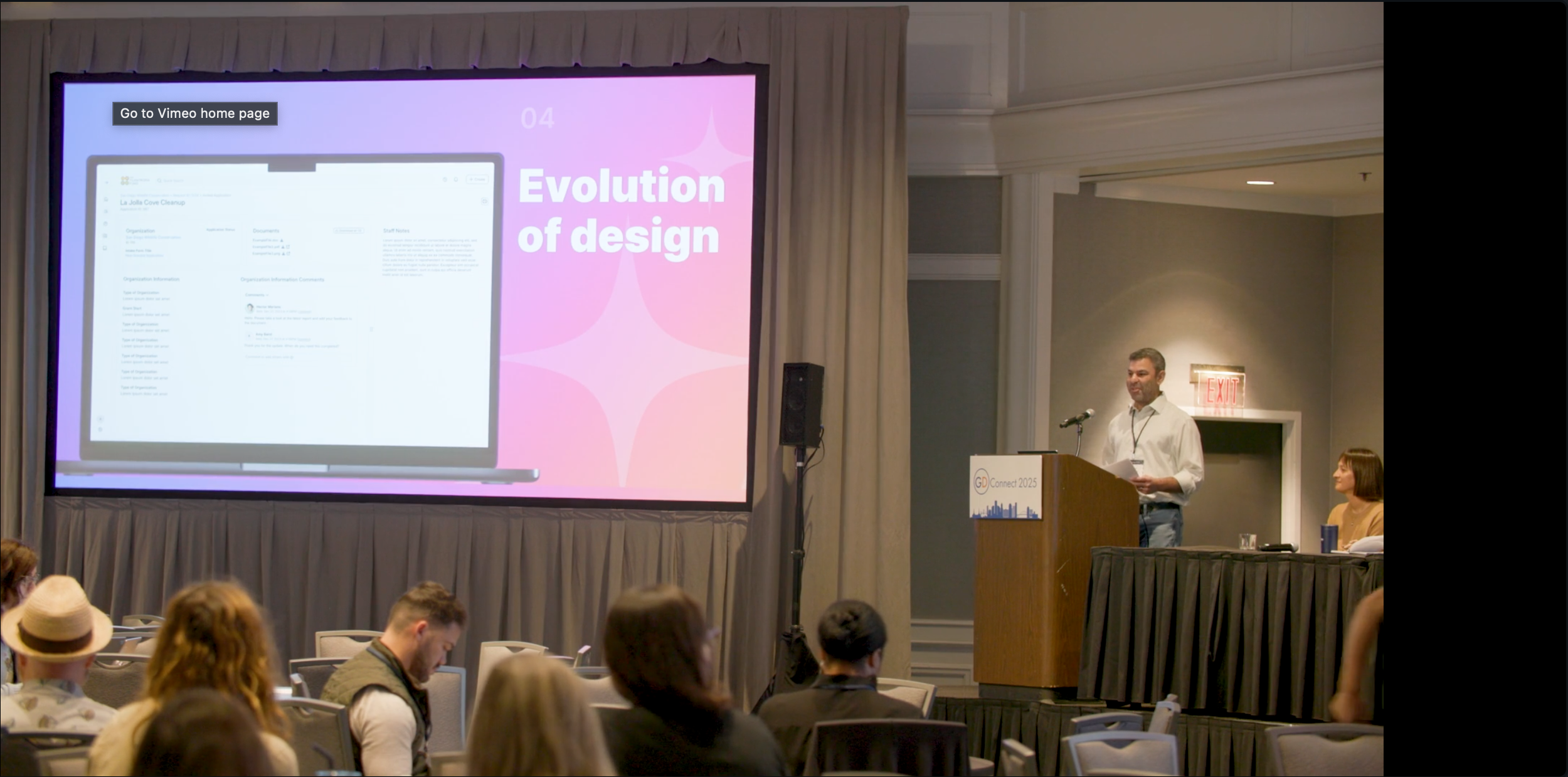
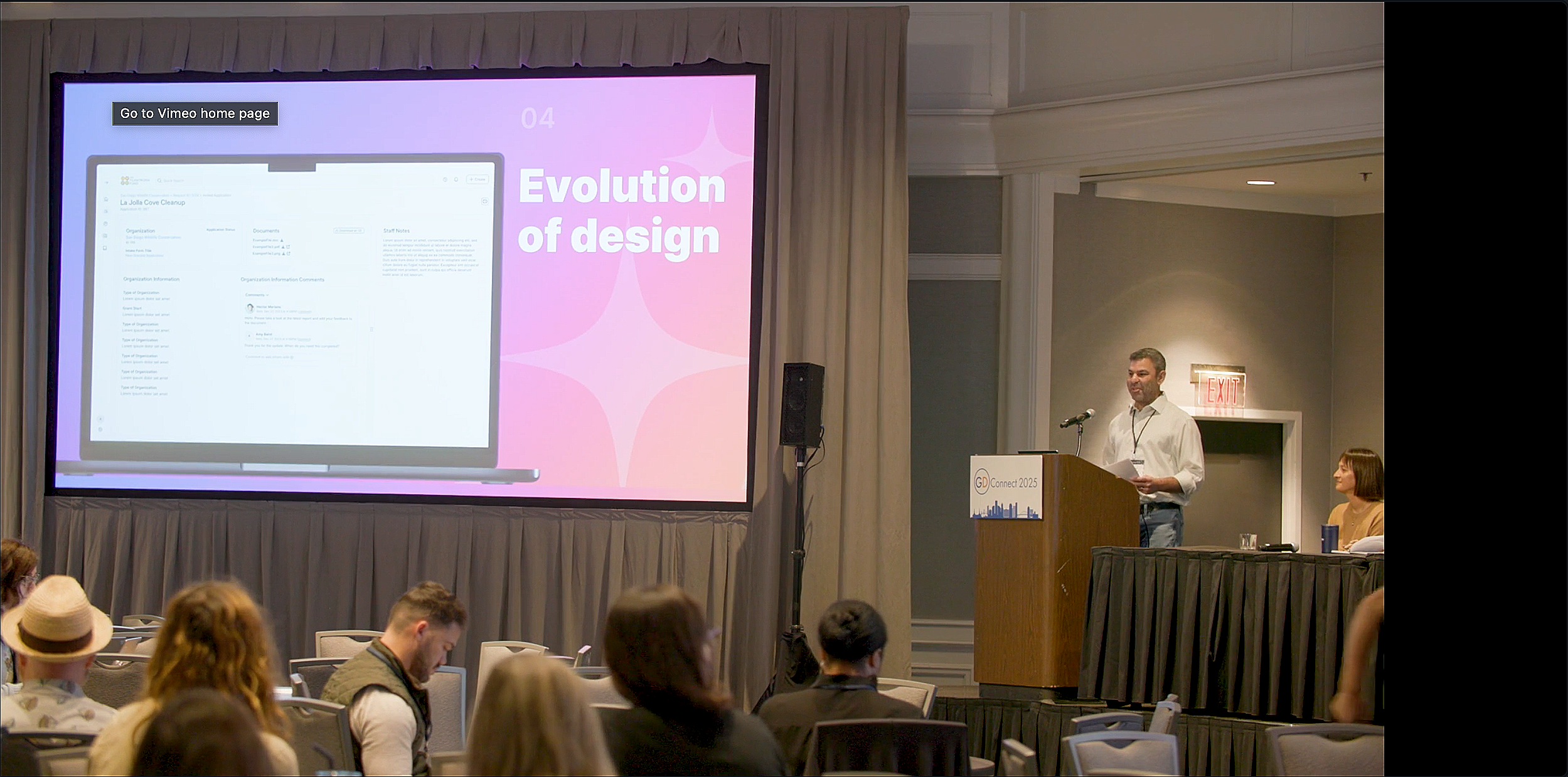
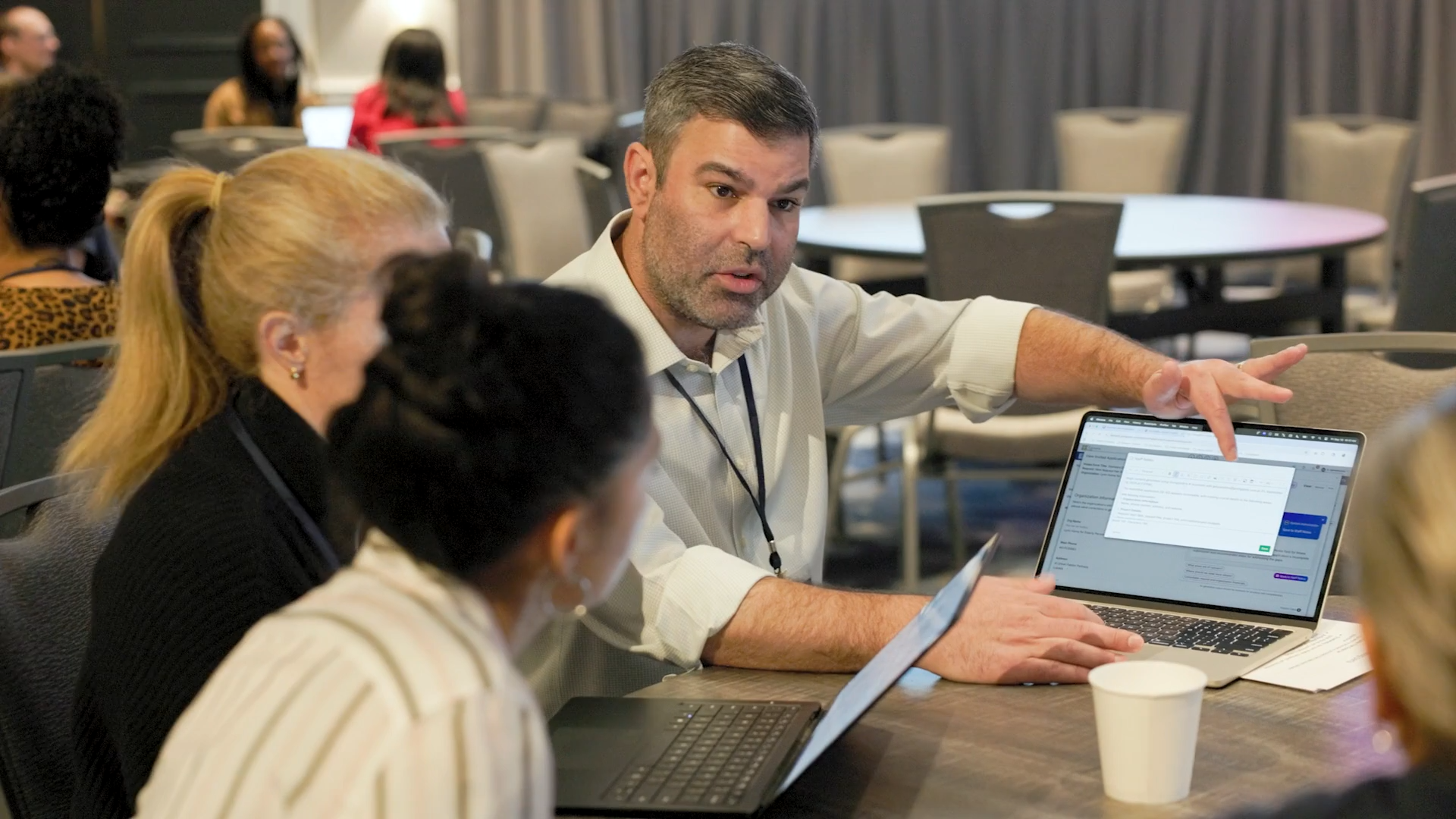
That energy followed us to the annual user conference, where I ran a client education session on features we had shipped, and presented “Evolution of Design at GivingData” on the main stage for the product reveal.
AUTUMN 2025 UNLOCK: Turns out, being genuinely outgoing is a design skill. Showing clients features you designed, on a stage, with charm and clarity — that moves product adoption in ways no prototype can. Designers who can carry a room are rare. I didn't fully appreciate that until Portland.
2025 Results
The signal was real
At year end I was recognized by leadership for bringing the platform's design and product experience meaningfully forward, and for doing it in a way that brought the team forward too.
Presenting AI previews on the main stage at GDConnect was a milestone, but the client response told us something important. clients had specific, considered expectations for AI in their workflows. That was important signal in an emerging AI space.
At the end of 2025, I was asked to join a new product team to help design an AI capability they were trying to implement.
Part 2: Trusted with more
January 2026
After GivingData was acquired in 2025, I spent two months supporting Foundant Technologies’ Grant Lifecycle Manager (GLM) product, helping implement an AI capability that the Labs team had built. They liked my approach. It became a formal reassignment.
What I inherited was significant. This product had ten times the clients and revenue of my previous team, a designer who recently departed, and a long list of things that needed to be worked on.
Last year was just a warmup.
Actions Taken
Invention under contstraint
While design had been on pause, the team was still moving through a frontend tech stack upgrade. The team was moving fast, and there was no Figma component library, a lot of legacy styling that was being phased out, and 2 examples of where the platform was going
I had two run-of-the-mill options: Ask the team to wait while I build out everything properly, or start delivering slowly without it. Neither option was acceptable to me.
Instead, I gave Claude a bunch of context:
Screenshots of the product
Style references
Basic page structure
An understanding of what the system is for and what does
What emerged was a real prototyping capability, reusable Claude artifacts that could be reused in any new chat or conversation.
FEBRUARY 2026 UNLOCK: The constraint that felt like a blocker was actually the forcing function. When the old tools aren't available, you find out what you actually need.
AI Native Design Sprint
Alongside catching up on the roadmap and building prototype infrastructure, I was leading a significant redesign of a core record page. One of the most used surfaces in the product, and a rare opportunity to rethink it from the ground up, not just refresh it.
Design sprints are coordination nightmares. Hours of meeting time, facilitation overhead, energy spent generating raw material instead of making decisions about it. Busy product teams don't usually have that kind of time.
Instead, I used Claude to shortcut the whole process, so the team could spend their time on the much more fun task of refining, debating, and deciding.
With Claude, we:
Drafted study session guides and questions
Distilled study transcripts into themes
Shaped themes into a problem statement and How Might We questions
Invited Claude as the eighth participant in a Crazy 8s session
Built an interactive impact/effort matrix, with our predefined criteria, to prioritize over 50 ideas. The CTO jumped into the thread: “I'm late to this thread, but this is awesome!”
Generated an “Iteration Burst” of 15 prototype concepts from the prioritized matrix, using the new prototype system instead of Figma
2026 UNLOCK:The design sprint doesn't need to be faster. It needs to be better. When AI handles the generation, humans get to do the only part that actually matters: deciding what's worth building.
Trust Between Clients and AI was the Hard Part
The AI feature we were implementing landed in a domain where technology adoption was historically slow, but new generations of workers have elevated expectations for how software should look and work. Being the first visible AI feature in the platform we had a lot of questions. I proposed a structured pilot, to understand whether clients would be able to find, use, and trust it enough to act on it.
I invited the Labs team to the pilot sessions. I messaged them directly, explained what we were learning, and made space for them to participate. They started showing up and invited leadership. What began as a research exercise became a shared intelligence operation across product and Labs.
What we found:
Discoverability: Clients couldn't locate the feature without guidance. Entry points weren't matching their mental models.
Setup friction: Configuration was a barrier for everyone except the most experienced AI users. Too many steps before any value was visible.
Trust & confidence: Real hesitation around AI overconfidence — deriving conclusions from sparse data, no way to preview prompting effectiveness before applying to live work.
Underlying enthusiasm: Beneath the hesitation, genuine excitement. Clients wanted this to work. They just needed to believe it would.
That last finding mattered as much as the barriers. The appetite was real. The friction was fixable.
SPRING 2026 UNLOCK: Trust research in a skeptical domain is different from usability testing. You're not asking “Can they use it?” You're asking “Will they believe it?”. That’s a guiding principle regardless of whether an AI or a human is writing your research plan.
2026 Results
What's emerging
AI-native prototyping changed the team's velocity immediately. Designs that would have waited weeks started shipping within days.
My PM mentioned she missed being able to leave comments on prototypes the way she could in Figma. Four hours later we had a working website that did exactly that. It's now being evaluated for internal hosting.
The pilot findings landed directly in the product roadmap. The Innovation VP committed to bringing setup interactions to near zero in v2. The decision to continue rollout in live client environments rather than sandbox came directly from what we heard in the room.
Client feedback was already happening, but informally, with the kind of leading questions that produce reactions rather than insight. The prototype gallery creates a direct, unfiltered channel. Comments go straight from clients to a dataset we can feed back into Claude for analysis, the same way we now handle transcripts, interviews, and research notes. The feedback loop isn't new. It's just finally structured enough to be useful.
What I Believe Now
The Product Design role is being rewritten. AI will keep improving on every front: UI generation, code output, synthesis, speed. PMs are designing screens. Engineers are shipping features without a designer in the room. The floor for everyone is rising.
The ceiling for designers is rising too, for those who lean back into what made this work special to begin with. Getting close to users. Surfacing unbiased insight. Reading what someone isn't saying in a research session. Bringing that back in a form that changes what gets built.
No AI built trust across product and sales, or proposed the pilot study to the team. No model earned the trust of foundation clients, navigated their skepticism, or recognized that the enthusiasm underneath the hesitation was the most important finding in the room. That required a human who knew what to listen for, and who had spent the time understanding the domain to know why it mattered.
The speed advantage is real and it compounds. But speed without rigor just ships the wrong thing faster. The designers who thrive are the ones who bring both: the velocity that AI enables and the judgment, empathy, and research discipline that AI can't replicate. At least not for now.
The bar has risen. And the constraint that kept designers downstream just evaporated. What's left is the actual job.
The one thing I'm most certain of is that I'm probably wrong about some of this. The models will keep improving. The role will keep shifting. What feels like clarity today might look like a quaint snapshot six months from now. And honestly? That's the part I find most energizing. We get to figure it out all over again.